

Every Dollar Counts
Here’s what we hear all the time from nonprofit leaders: “Video sounds great in theory, but we don’t have the budget. Our staff is stretched thin. We’re already doing social media and email. Is video really worth the investment when every dollar counts?”
It’s a fair question. Nonprofits operate under real constraints, and the pressure to do more with less is relentless. There’s also a common misconception that you must invest heavily in professional video production, or you don’t bother with the video campaign. The truth is more nuanced. 57% of people who watch a video about a nonprofit go on to make a donation[1]. That conversion can happen whether your video was shot on an iPhone or a cinema camera. In this article, we’ll discuss more in depth which types of videos can be DIY and which should be a budgeted marketing expense.
57% of people who watch a video about a nonprofit go on to make a donation
– Google & Millward Brown Digital
In both cases, adopting video into your fundraising strategy is more accessible than people think. What matters is authentic storytelling, emotional connection, and strategic placement. When properly implemented, it’s a critical asset that can deliver exceptional returns, even on limited resources.
Benefits of Incorporating Video Storytelling
Increased In-Person Donation Rates
Your annual gala is where magic happens. It’s where your wealthiest and most committed donors gather in one room, and it’s the perfect moment to deploy a video that hits them emotionally and moves them to action.
Our nonprofit clients often ask for donations in the room, after the audiences have listened to real people tell their story. It’s an amazing opportunity for attendees to connect and make a difference while surrounded by both the people they are helping, and the people who have made it possible.
Increased Online Donation Rates
Video provides the answer to the question every potential donor is silently asking when scrolling through social feeds: “Why should I care?” When someone watches a video about your work, they’re no longer making an abstract decision. They’re responding to a real person and a real need.
When you add video to your social campaign, you’re showing up in the spaces where they’re already looking instead of asking them to come find you elsewhere.
The real power emerges when video works across your entire fundraising strategy. Video on social posts drives more engagement and attention[2]. Video on a donation page converts at higher rates[3]. Each channel works harder because donors have already encountered your story in multiple formats, building familiarity and trust.
Boosted Website SEO (For Blogs and Landing Pages)
Unique video tells search engines that your content is valuable. When someone lands on a page with video, they naturally stay longer because they’re watching something. Search engines notice this engagement and reward it by ranking your pages higher in results. Paired with a proper SEO strategy, this means more people find you without paying for ads. More organic traffic. More potential donors discovering your organization just by searching for topics related to your mission.
An embedded explainer or testimonial video on your nonprofit landing page can increase conversions by 86%, making video a critical asset for fundraising pages[3]. That extended engagement signals value, and that improves your search visibility over time.
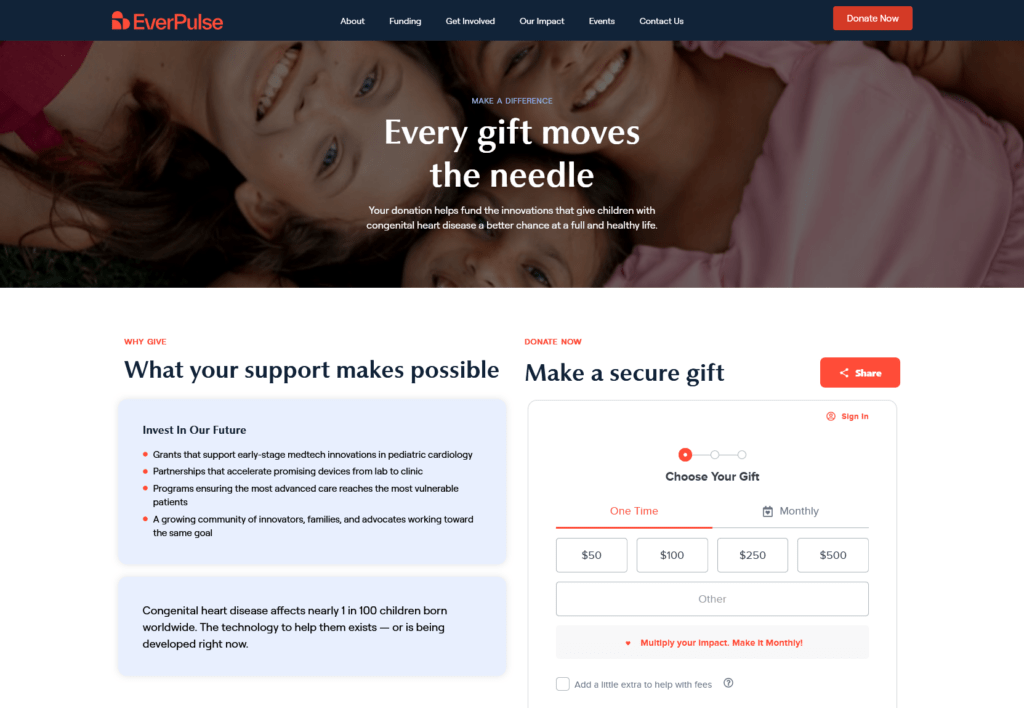
EverPulse, a nonprofit for pediatric medical device research and development, hired Lightpost Studios to redesign their website. This is a look at the updated donation form and landing page.
How to Utilize Social Media Channels
Facebook is your go-to channel for turning video into donations.
Facebook’s built-in fundraising tools also mean donors can give without leaving the platform. It has the strongest proven connection between following a nonprofit and actually giving, whether online or in person[4]. Plus, when your video storytelling hits emotionally, Facebook’s algorithm amplifies it to people who care about similar causes.
YouTube is where your videos build credibility and get discovered.
When someone searches for information about your cause, YouTube videos show up. Research shows 70% of donors watch nonprofit videos to understand your impact before deciding to support you[1]. It’s not just about donations, it’s about being found by the people who need to know about your mission.
Instagram is your community-building hub.
Instagram’s algorithm naturally boosts your content to users interested in similar communities. In fact, Instagram reaches 15.3% of your followers with organic posts (significantly higher than Facebook’s 2.2% or LinkedIn’s 2.9%), making it exceptional at expanding your awareness beyond your current followers[5]. While Instagram doesn’t have as direct a donation path as Facebook, it’s where you deepen relationships with supporters who already care about you and reach new ones who share your mission’s values.
LinkedIn is for institutional donors and major gift conversations.
Foundation officers, corporate partners, and wealthy individuals research nonprofits here. Videos about your innovation, vision, and leadership position your organization as trustworthy and forward-thinking. In fact, 42% of US donors use LinkedIn to research nonprofits, and 26% discover donation opportunities directly on the platform[5].
TikTok is your long-term investment in future supporters.
Younger audiences find you here through authentic, behind-the-scenes content. They might not donate today, but you’re building relationships with tomorrow’s donors.
Research shows the most effective nonprofits don’t pick just one channel. They focus their limited resources where donors actually are: Facebook and YouTube first, then expand to Instagram and LinkedIn based on their audience.
Micro-Influencers are your most accessible partners.
Work with voices in your community, not celebrity endorsers. Nonprofits often assume influencer partnerships require celebrity budgets. The truth is more powerful: micro-influencers (10,000-100,000 followers) in your cause space are far more effective at driving authentic engagement and donations than major celebrities.[6] These creators already care about your mission and have highly engaged audiences that trust their recommendations.
Micro-influencers (10,000-100,000 followers) in your cause space are far more effective at driving authentic engagement and donations than major celebrities.
– Gwen McGarry
Research from M+R’s “Put Families First” campaign, which tested nearly 2,200 ad variants across political and advocacy messaging, found that personal storytellers and microinfluencers were the strongest performers, generating the highest click-through rates out of all creative tested.[6] More importantly, real people sharing authentic stories about your cause increased likelihood to take action by 2.5 to 3.6 percentage points across different audience segments, significantly outperforming polished traditional advertising.[6]
When reaching out to micro-influencers, offer value instead of payment. Many will share your content for free if they genuinely believe in your work. Consider gifting a volunteer experience, naming recognition, or exclusive behind-the-scenes access to your programs. The most successful nonprofit-influencer partnerships feel like natural endorsements, not sponsored posts. Authentic personal storytelling, where influencers speak in their own voice about why your mission matters, consistently outperforms manufactured or overly polished creative across all audience types.[6]
Five Types of Videos Every Nonprofit Should Consider
We’ve seen which types of nonprofit videos consistently move the needle on both engagement and donations. You don’t need to produce all of these at once. Instead, think of building a small library over time, with each type serving a specific purpose. One professionally produced video can often be edited into multiple lengths and formats for different platforms. So you’re not quadrupling your workload; you’re being smart about one investment.
1. Emotional Testimonials
What’s it about? Let the people you serve tell their own stories of transformation. This is often the most powerful video a nonprofit can create.
Imagine a single mom describing how your job training program changed her life and allowed her to buy a home. Or a student sharing how your scholarship opened doors she didn’t know existed. Or a patient explaining their recovery journey in their own words. These stories do the heavy emotional lifting that no narrator could ever do.
Clients We’ve Done This For
How to make it great: Truly focus on the individual and their journey. It’s absolutely essential to ensure the interview feels natural and allows the speaker to cover the breadth of their story. These videos often feel like documentaries and are the best place to invest your dollars on more professional video services.
Where it shines: Almost everywhere. Shorter versions are created for social media reels and stories. It can also be used in email fundraising campaigns, donation landing pages, and year end appeals.
2. Impact Focused Videos
What’s it about? Show concrete outcomes and prove that donations create measurable change. These videos answer the question every donor wants answered: “Did my money actually make a difference?”
Donors want evidence. They want to know that their generosity resulted in real, quantifiable change. Whether that’s meals served, students graduated, lives improved, or policies changed, impact videos prove it.
Clients We’ve Done This For
How to make it great: Balance data with human stories. Pair statistics with specific outcomes that prove your point. Instead of saying “500 families received food support,” say “500 families, enough to fill our local high school gym, received food security support this year.”
Where it shines: Grant applications, board reports, investor pitches, campaigns tied to fundraising goals, and annual reports.
3. Innovation Focused Videos
What’s it about? Nonprofits are constantly evolving and trying new approaches. These videos showcase what’s new, why it matters, and what cutting-edge innovation might differentiate the nonprofit. Maybe you just launched a virtual tutoring program. Maybe you developed a breakthrough therapeutic approach. Maybe you created an app that’s solving a real community problem. These videos position your organization as a forward-thinking leader.
Clients We’ve Done This For
How to make it great: Start by explaining the problem (“We realized rural communities couldn’t access our services”). Then introduce the innovation (“So we built this platform”). Then show it in action with real people using it. Focus on the why. What gap does this fill? Why does it matter now?
Where it shines: Social media campaigns, website highlights, media outreach, foundation pitches, and donor briefings.
4. Historical Videos (The Foundation’s Origin Story)
What’s it about? These videos tell the why behind your organization. Why does your nonprofit exist? What sparked the mission?
Maybe your founder personally experienced the problem you’re solving. Maybe they witnessed injustice that wouldn’t leave them alone. These videos create context and meaning around everything your organization does. They answer the question people are really asking: “Why should I trust and support this organization?”
Clients We’ve Done This For
How to make it great: Focus on the catalyst of the foundation’s formation and its mission. Feature the founder or early team members. Their passion and voice are part of the story. Use old photos, archival footage, or subtle reenactments to bring history to life. End by showing how that original vision is alive and thriving today. These videos can be handled professionally, but they can also be fairly simple videos handled internally, depending on their usage.
Where it shines: Your website homepage, grant applications, year end giving campaigns, and board presentations.
5. Event Recaps and Thank You Clips
What’s it about? These capture the energy and community spirit of your fundraising events, galas, or volunteer gatherings. Personalized thank you messages from leadership to supporters is a simple, authentic gesture that strengthens relationships and encourages repeat giving.
How to make it great: Event recaps can still thrive with simple editing. Use footage from your event (phone videos are fine), add quick clips of attendees, speakers and event activities with catchy music. Thank you videos can be as simple as your executive director speaking directly to the camera with genuine gratitude. Keep both under two minutes. These are the easiest videos to DIY internally with zero production budget.
Where it shines: These are perfect for email follow-ups, social media, and donor retention. They show supporters the immediate, tangible impact of their involvement. They also build momentum for your next event and reinforce donor relationships without requiring any external resources or technical expertise.
How to Get Started
What really matters is authentic storytelling, emotional connection, and a clear ask. Pick one video type to start with. Maybe an impact story or a founder testimonial. Produce it thoughtfully, then use it everywhere: email, social media, your website, board meetings. Once you see the results (and the metrics suggest you will), expand your video library from there.
The donors waiting to support your mission are already out there. Video is simply the most effective way to help them see themselves in your organization’s story and feel moved to give.
Sources
[1] Google & Millward Brown Digital. “Mission 501(c)(3): Driving Donations, Digitally”
https://www.thinkwithgoogle.com/_qs/documents/666/digital-non-profits-study_research-studies.pdf
[2] U.S. Chamber of Commerce. “6 Social Media Strategies for Nonprofits.”
https://www.uschamber.com/co/grow/marketing/social-media-strategies-for-nonprofits
[3] WordStream “Great Landing Pages”
https://www.wordstream.com/blog/ws/great-landing-pages
[4] Boulianne, S. “Standby Ties that Mobilize.”
https://pmc.ncbi.nlm.nih.gov/articles/PMC10240620/
[5] Nonprofit Tech for Good. “2026 Social Media Statistics for Nonprofits.”
https://www.nptechforgood.com/101-best-practices/social-media-statistics-for-nonprofits/
[6] M+R (2025). Real Stories Win: Lessons from a Persuasion Experiment, by Gwen McGarry.
https://www.mrss.com/wp-content/uploads/2025/09/2025-White-Paper.pdf